A research project at Cardiff Metropolitan University is investigating the potential of plant-derived essential oils as new treatments for chronic wound infections, a growing but often overlooked health challenge affecting more than 3.8 million people across the UK.
Chronic wound infections place a burden on patients and healthcare systems comparable to conditions such as diabetes and cardiovascular disease. But treatment options are becoming increasingly limited due to the rise of antimicrobial resistance; so with few new antibiotics in development, researchers are turning to nature for alternative solutions.
Dr Sarah Hooper, Reader in Microbiology and Infection at Cardiff Met, said: “For centuries, plant-based remedies have been used in traditional medicine to treat infection. Modern research has confirmed that many plants contain complex mixtures of bioactive compounds capable of antimicrobial and anti-inflammatory activity. Essential oils extracted from plants in the Lamiaceae family, such as thyme, oregano, basil, rosemary, and sage, have consistently shown strong activity against harmful bacteria in laboratory studies.”
Despite these promising results, essential oils are not currently used in clinical wound care. The obstacles include limited human data, inconsistent results in studies, safety concerns, and challenges associated with standardising extraction methods.
To address these challenges, the Cardiff Met team screened ten essential oils from the Lamiaceae family for their effectiveness against two common wound pathogens, Pseudomonas aeruginosa and Staphylococcus aureus. The study aimed to identify which chemical components were associated with the strongest antimicrobial effects and to determine whether the most effective oils could be successfully incorporated into a topical hydrogel suitable for wound application.
Dr Hooper said: “Our findings move essential oil research beyond traditional laboratory testing by linking detailed chemical composition with functional performance in a realistic wound model. Even oils that come from closely related plants can work very differently against bacteria. The effectiveness of an oil doesn’t just depend on its main ingredients, but also on tiny amounts of other compounds, how the oil is prepared, and how it’s applied or delivered. Our next step therefore is to grow plants in the lab in very precise conditions, so that we can hopefully develop a standardised oil that is sustainable to produce.”
“There are still a lot of challenges to overcome, but by linking detailed chemical testing with how these products perform, and by exploring improved ways to deliver them, we could develop new plant-based wound treatments that may help support healing and reduce dependence on traditional antibiotics.”
This project is part of a collaborative effort with Prof Chris Wallis, an expert in sustainable compounds of natural origin, and Matt Bates an expert in chemical analysis of plant oils.
Britain’s landscape is highly fragmented by roads, with researchers from Cardiff University finding that more than 70% of the UK’s roadless areas are smaller than 1 km2.
The researchers say that more than 60% of roadless patches in the UK are smaller than the typical area many common UK mammals needs to survive, meaning species such as badgers and red foxes likely face a high risk of wildlife-vehicle collisions.
Dr Sarah Raymond, who completed the work during her PhD at Cardiff University School of Biosciences, said: “Roads cover 20% of land globally, fragmenting land into almost 600,000 patches.
“Because of this, roads have a wide range of impacts on wildlife, including reduced habitat connectivity and wildlife-vehicle collisions. Wildlife-vehicle collisions are estimated to cause millions of animal mortalities on roads every year and are a leading cause of population decline and biodiversity loss.”
The researchers extracted and mapped roads across Great Britain from OpenStreetMap, an open-access geographic database, to calculate roadless areas in Great Britain. Both areas covered by roads and ‘road effect zones’ – the areas around roads that experience ecological effects – were mapped. The roadless areas were defined as patches of land unaffected by roads, beyond the road effect zones.
The researchers found that the total number of roadless patches across Great Britain was 6,138 with a 1km road effect zone, 29,164 with a 500m road effect zone, and 93,561 with a 100m road effect zone. The majority (71-74%) of roadless patches were smaller than 1km² in size, and a small minority (0.002-0.014%) were greater than 100km2.
Roadless patches were significantly larger in Scotland than England and Wales, with Scotland having the greatest percentage of roadless area and larger individual patches, primarily coinciding with the Scottish Highlands and Cairngorms National Park. England had the largest number of individual patches, but the lowest overall percentage of land that is roadless.
The researchers found that 53% of all roadless areas were not covered by existing protected habitat designations, highlighting a need to increase protection of roadless areas and connectivity between them.
Dr Perkins, who runs Road Lab at Cardiff University, added: “Nearly half (47%) of roadless areas overlap with existing protected sites, but often only partially. Protecting and connecting roadless areas offers a practical route to expanding our protected area network while reducing wildlife‑vehicle collisions.”
The findings of the study emphasise the extent to which Great Britain is fragmented by roads and the extent of their effects.
“The European badger has a home range greater than the majority – 73% – of roadless patches, putting them at high risk of wildlife-vehicle collisions compared to other species with smaller home ranges,” added Dr Raymond.
Cardiff Metropolitan University has been recognised nationally for excellence and creativity in student recruitment, scooping two prestigious awards at the 2026 HELOA Awards.
Cardiff Met won Best Practice in Student Recruitment for the University’s ‘Help! I’m Going to Uni’ podcast and Best Undergraduate Initiative for ‘Get Cardiff Met Ready’.
The HELOA Awards celebrate outstanding work across UK universities in student recruitment, outreach and access, and are voted for by peers from other higher education institutions.
Cardiff Met’s ‘Help! I’m Going to Uni’ podcast uses innovative ways of supporting prospective students and tackles the real anxieties of starting university with honesty, humour and authenticity.
Featuring diverse student voices, the podcast has become a standout tool for the University to connect with applicants and has been woven into Cardiff Met’s campaigns, live events and prospectus content.
The ‘Get Cardiff Met Ready’ pre-enrolment event recognises its impact on helping new students feel confident, connected and prepared to begin university life.
Held on campus before enrolment, the event offers practical sessions, student-led talks and interactive activities to ease anxieties and build belonging. Over 880 students attended in 2025, a 14% increase on the previous year, and 94% said they felt more prepared to start their studies.
Rebecca Lever, Chief Marketing, Communications and Student Recruitment Officer at Cardiff Metropolitan University said: “Both initiatives show our creative thinking and commitment to continuous improvement.
“These latest wins highlight Cardiff Met’s commitment to innovation, collaboration and putting students at the heart of everything we do. Well done and thank you to everyone involved.”
‘Help! I’m Going to Uni’ is available for streaming on major platforms, including YouTube, Spotify and Apple Podcasts.
Aston University researchers send data at 430 terabits a second (Tb/s) over standard telecom fibre
Researchers from the Aston Institute of Photonic Technologies are part of an international team based in Japan
In their latest demonstration the team broke their own earlier record using nearly 20% less overall bandwidth.
Aston University researchers are part of the team that sent data over the internet at the world record rate of 430 terabits a second (Tb/s) over standard telecom fibre. A basic home connection is just10 megabits per second.
Dr Aleksandr Donodin and Professor Sergei Turitsyn from the Aston Institute of Photonic Technologies (AIPT) are part of an international team, led by Japan’s National Institute of Information and Communications Technology (NICT). AIPT researchers were also part of the team holding the previous world record of data transmission of standard fibre at 402 Tb/s.
In their latest demonstration the team led by NICT broke their own record using nearly 20% less overall bandwidth, resulting in a simpler system design proving that the existing infrastructure can be further improved without costly upgrades.
The new method is based on standard optical fibre technology that is widely installed in commercial fibre networks. In over five billion kilometres of fibre-optic cable deployed around the globe the lion’s share is based on single-mode fibre. The technique has the potential to be applied where standard telecom fibre is already installed. This would include urban area networks and data centres interconnects (the technology used to connect two or more data centres to share data and resources) where high-capacity connections are increasingly in demand.
The technique can offer more capacity without deployment of new fibre or much wider spectral bandwidth. In addition, it could be cheaper and more efficient as cables that are already in the ground could be used, rather than digging up streets to install new ones and upgrades could happen faster.
Dr. Donodin said: “New technology can offer more capacity without needing new fibre. It extends the capacity of standard-compliant cutoff-shifted optical fibres well beyond the original design. Wavelengths below the cutoff point allow us to transmit data separately in different modes, which leads to significant increase of spectral efficiency. In this work we performed 3-mode transmission in the O-band while transmitting data in the fundamental mode in ESCL-bands.
“Compared to our earlier 402 Tb/s work, this new approach shows that we don’t always need more and more spectrum to increase capacity – we can improve how efficiently we use it.”
New, data-driven internet services, including AI, have driven a surge in demand for optical fibre transmission bandwidth. NICT is to continue its research and aims to extend the transmission range of wideband, ultra-high-capacity systems and their compatibility for fibres already in use.
Their findings were reported as a post deadline paper at the 51st European Conference on Optical Communication (ECOC) 2025 in Denmark on 2 October and was partly supported by the Japan-Germany Beyond 5G/6G collaboration initiative.
The twelve international collaborators are NICT (Japan), Aston University (UK), Fraunhofer Heinrich-Hertz-Institut (Germany), Eindhoven University of Technology (Netherlands), Politecnico di Milano and University of L’Aquila (Italy), University of Campinas (Brazil), University of Stuttgart (Germany), Sumitomo Electric Industries Ltd. (Japan), Macquarie University and Modular Photonics (Australia) and Nokia Bell Labs (USA).
Aston University research in this area is supported by the EPSRC Programme grant TRANSNET, Dr Donodin has been supported by Department for Science, Innovation and Technology and the Royal Academy of Engineering under the research fellowships.
Aston University’s Samantha Chapman has co-written a paper for the Royal College of Nursing on enhanced therapeutic observations
Enhanced therapeutic observations are a temporary measure used only when necessary for a patient, but come with challenges
The paper supports healthcare workers to provide dignified, respectful care and improve patient experience and recovery.
Samantha Chapman, a teaching fellow in mental health nursing at Aston University, has co-written a continuing professional development article setting out best practice on enhanced therapeutic observations for healthcare professionals.
Enhanced therapeutic observations (ETOC) are used in nursing when a patient requires closer observation for their health and wellbeing. There are different levels of ETOC, for example, constant observation of a patient within eyesight, or constant observation within arm’s length, as well as intermittent observations such as every 15 minutes. It is only a temporary measure used when absolutely necessary, but can present challenges, so it needs to be delivered with compassion, always ensuring dignity and respectful care.
Chapman co-wrote the article, Role of enhanced therapeutic observations and care in maintaining the well-being and safety of mental health inpatients, with lead author Helen Rees, professional lead nurse educator at Priory, the UK’s largest independent healthcare provider. It has been published as a continuing professional development (CPD) article by the Royal College of Nursing and is designed to support nurses, nursing associates and healthcare support workers.
One of the biggest challenges is the amount of time healthcare staff and the patient will spend together during periods of ETOC. The article looks at how this longer period of contact can be delivered in a therapeutic and meaningful way to support the patient in their recovery, avoiding relationship burnout.
Chapman and Rees were concerned that there was very little in the literature about ETOC, and that the type of observation goes by many different names. In writing the article, they have sought to unify the published knowledge and provide evidence-based information to share with nurses, nursing associates and healthcare support workers, as well as students on healthcare courses.
Chapman said:
“More research is needed in this area to explore how enhanced therapeutic observations can and should be delivered to be recovery focused and a supportive intervention for the patient. They should not be a tick box exercise, and they do require a lot of emotional intelligence and therapeutic skill on behalf of the healthcare staff delivering the care.
“It is hoped that this article enables these important discussions to be expanded, to encourage others to think about how these observations are delivered ensuring the patient is at the centre of care provided.”
The Centre for Economy, Policy and Place at Nottingham Business School (NBS) is to hold a special event which brings together Claire Ward, mayor of the East Midlands Combined County Authority (EMCCA), and Aki Takehisa, former mayor of Setouchi City, Japan.
By Helen Breese |
Aki Takehisa, former mayor of Setouchi City, Japan, and Claire Ward, mayor of the East Midlands.
The in-conversation style session on Thursday 15 January 2026 will see Claire and Aki explore critical themes such as devolution, fiscal autonomy, and the balance between economic growth and wellbeing. They will also delve into the importance of place-based identities and consensus building in multi-level governance.
Claire Ward is the inaugural mayor of EMCCA, elected in 2024 to champion regional economic growth, transport infrastructure, and skills development. Her vision emphasises collaboration across local councils and central government to deliver inclusive prosperity for communities in the East Midlands.
Aki Takehisa served as mayor of Setouchi City, Japan, for 16 years (2009–2025), leading initiatives on inclusive growth, wellbeing, and sustainable development. A former councillor, he earned an MBA in Public Service from the University of Birmingham and worked with Deloitte as a consultant to local authorities. He also taught public management at Kwansei Gakuin University. Currently, he is a visiting researcher at Nottingham Business School, pursuing a PhD on mayoral accountability in Japan and the UK.
The event is the first in a new series of events promoted by the Centre for Economy, Policy and Place at NBS, Nottingham Trent University, which combines research on economic and public policy with a focus on place, public services, and applied economics.
Following opening remarks from Professor Dave Petley, vice-chancellor of Nottingham Trent University, keynote insights will be provided by Professor Anne Green from City-REDI at the University of Birmingham, whose research examines comparative approaches to mayoral governance in England and Japan.
The mayoral discussion will be hosted by Will Rossiter, centre director and Professor of Regional Policy and Development at NBS.
Professor Rossiter said: “This event marks an exciting moment for the Centre for People, Policy and Place. By bringing together leaders from the UK and Japan, we aim to explore how mayoral governance can shape inclusive, sustainable growth and strengthen the connection between policy and place. It’s a unique opportunity to share insights across international contexts and learn from different approaches to leadership.”
The session, which will take place from 6 – 7.30pm on Thursday 15 January 2026, will conclude with a Q&A and reflections from Professor Anne Green.
Cardiff Metropolitan University was delighted to welcome Deputy First Minister and Cabinet Secretary for Climate Change and Rural Affairs Huw Irranca-Davies onto campus this week, for his announcement of Welsh Government’s £15 million plus Digarbon loan scheme supporting the tertiary education sector to reach carbon net zero by 2030.
Deputy First Minister Huw Irranca-Davies said: “We are pleased to see the continued efforts of the tertiary education sector in Wales in driving ambition to decarbonise. This latest investment through Digarbon reflects our commitment to supporting Wales’s tertiary education sector in cutting emissions, reducing energy costs, and accelerating progress towards net zero.”
The Digarbon low-interest loan scheme is funded by the Welsh Government and delivered by Salix in alignment with the UK’s national target to achieve net zero greenhouse gas emissions by 2050. Cardiff Metropolitan University has been awarded £6.2 million from the scheme. Others to receive to receive funding are Swansea University, Bangor University and Coleg Cambria. The Digarbon investment will enable these institutions to modernise their buildings and infrastructure, reduce energy costs, and accelerate Wales’ transition to a sustainable, low-carbon future.
Cabinet Secretary for Education, Lynne Neagle said: “It’s wonderful that these four Welsh universities and colleges are leading the way in creating more sustainable learning environments for their learners and communities. Through Digarbon we’re enabling our education institutions to provide learners with modern, energy-efficient spaces that support their learning.”
Cardiff Metropolitan University will use the low-interest loan to deliver on the University’s award winning “Halve the Half” initiative cutting greenhouse gas emissions, reducing costs and supporting community access to the University’s extensive sports facilities.
Work will focus on the swimming pool, which is heavily used by community groups, children’s swimming lessons, student athletes and leisure swimmers. The pool will transition to low-carbon heating and ventilation systems, and solar panels and a battery storage system for renewable energy will be installed. These upgrades will also improve a sports hall, squash courts and several teaching and administration spaces. The result of these works will be to eliminate gas use in the University’s most energy-intensive building while halving grid electricity demand at the Cyncoed campus.
President and Vice-Chancellor of Cardiff Metropolitan University, Professor Rachael Langford said: “We are delighted to have been able to show the Deputy First Minister the improvements made through previous Ynni Cymru funding and our Halve the Half initiative, our genuinely ‘made in Wales’ innovation led by Cardiff Met which is impacting building design standards and cross-sector collaboration across the UK.
“The new funding will support us to continue to demonstrate how carbon reduction policies and priorities can be used to achieve operational change, targeted capital investment and widespread community benefit while also significantly reducing environmental and climate impact.”
Salix chief executive Kevin Holland said: “Salix is proud to partner with the Welsh Government to deliver this vital loan funding, marking a major milestone on Wales’ journey toward net zero. These projects represent real, measurable progress to create a more sustainable future and to reduce energy costs. We look forward to seeing the works in action, meeting the inspiring teams driving this transformation, and collaborating closely with stakeholders to ensure their lasting success.”
Cardiff Met has an impressive track record in environmental sustainability over a number of years. Most recently, its energy reduction ‘Halve the Half’ initiative won ‘Outstanding Contribution to Environmental Leadership’ at the prestigious Times Higher Education Awards, and Best Use of Technology at the Construction News TechFest awards. The University was also ranked first in Wales and top 10 in the UK People and Planet University League 2025/26.
Scientists have found wolf remains, thousands of years old, on a small, isolated island in the Baltic Sea – a place where the animals could only have been brought by humans.
The study, published in Proceedings of the National Academy of Sciences by researchers at the University of East Anglia, Francis Crick Institute, Stockholm University and the University of Aberdeen, suggests that grey wolves may have been managed or controlled by prehistoric societies.
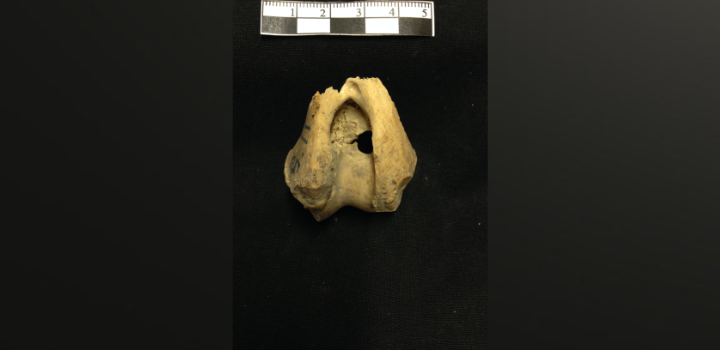
The discovery of the 3,000–5,000-year-old wolf remains was made in the Stora Förvar cave on the Swedish island of Stora Karlsö, a site known for its intensive use by seal hunters and fishers during the Neolithic and Bronze Ages.
mage: A fragment of some of the wolf remains discovered
The island, which covers only 2.5 square kilometres, has no native land mammals, meaning that any such animals must have been brought there by people.
Bone analysis
Genomic analysis of two canid remains confirmed they were wolves, not dogs, with no evidence of dog ancestry. However, they exhibited several traits typically associated with life alongside humans.
Isotope analysis of their bones revealed a diet rich in marine protein, such as seals and fish, aligning with the diet of the humans on the island and suggesting they were provisioned. Furthermore, the wolves were smaller than typical mainland wolves, and one individual showed signs of low genetic diversity, a common result of isolation or controlled breeding.
Dr Anders Bergström of UEA’s School of Biological Sciences and co-lead author, said: “The genetic data is fascinating. We found that the wolf with the most complete genome had low genetic diversity, lower than any other ancient wolf we’ve seen.
”This is similar to what you see in isolated or bottlenecked populations, or in domesticated organisms. While we can’t rule out that these wolves had low genetic diversity for natural reasons, it suggests that humans were interacting with and managing wolves in ways we hadn’t previously considered.”
Living alongside humans
“The discovery of these wolves on a remote island is completely unexpected,” said Dr Linus Girdland-Flink of the University of Aberdeen, a lead author of the study. “Not only did they have ancestry indistinguishable from other Eurasian wolves, but they seemed to be living alongside humans, eating their food, and in a place they could have only have reached by boat. This paints a complex picture of the relationship between humans and wolves in the past.”
The finding challenges the conventional understanding of wolf-human dynamics and the process of dog domestication. While it remains unclear if these wolves were tamed, kept in captivity, or managed in some other way, their presence in a human-occupied, isolated environment points to a deliberate and sustained interaction.
“It was a complete surprise to see that it was a wolf and not a dog,” said Pontus Skoglund of the Ancient Genomics Laboratory at the Francis Crick Institute and senior author. “This is a provocative case that raises the possibility that in certain environments, humans were able to keep wolves in their settlements, and found value in doing so.”
One of the wolf specimens, dated to the Bronze Age, also showed evidence of injury in a limb bone, which would have limited its mobility. This suggests it may have been cared for or was able to survive in an environment where it did not need to hunt large prey.
Unexpected perspectives
The combination of osteology and genetic analyses have provided unique information not available separately.
“The combination of data has revealed new and very unexpected perspectives on Stone Age and Bronze Age human-animal interactions in general and specifically concerning wolves and also dogs,” added Jan Storå, Professor of Osteoarchaeology at Stockholm University.
The study suggests that human-wolf interactions in prehistory were more diverse than previously thought, extending beyond simple hunting or avoidance to include complex relations and interactions that, in this case, mirrors new aspects of domestication without leading to the canines we know as dogs today.
‘Gray wolves in an anthropogenic context on a small island in prehistoric Scandinavia’ is published in Proceedings of the National Academy of Sciences on November 24.
The University of East Anglia (UEA) will once again be hosting free Christmas lectures for children on campus, with this year’s theme inviting families to explore the magic and mystery of the brain.
On Saturday 13 December, Prof Louis Renoult and Dr Martin Doherty from UEA’s School of Psychology will lead “Jingle all the Brain: Seeing is Believing?” – an interactive lecture exploring how our brains interpret memories and illusions through a Christmas lens.
Families can choose from two sessions (10am or midday), both hosted in Lecture Theatre 1 on the UEA campus. While recommended for children aged seven to 11, these lectures are open to all and will include a pop-up shop by Norwich Children’s Book Centre, as well as the chance to meet Father Christmas himself.
Tanner Barnes, UEA’s Public Events and Engagement Manager, said: “This annual event is a hallmark of the holiday season at UEA, a special opportunity to welcome families from the community to campus to experience a university lecture… with a festive twist.”
Professor Gemma Stacey, Associate Dean of Practice in the School of Social Sciences, explores whether current approaches to resilience in healthcare are addressing the wrong problem.
By Professor Gemma Stacey
Picture this: a newly qualified nurse sits in yet another mandatory resilience training session. The message is clear: develop better coping strategies, build resilience. At the same time, this nurse is working 12-hour shifts on an understaffed ward, navigating complex hierarchies where speaking up feels risky, and constantly managing the gap between the compassionate care they want to deliver and what the system actually allows. But apparently, the problem is a lack of resilience.
This scenario plays out across healthcare systems worldwide. The prevailing narrative is remarkably consistent: students and early career nurses lack the resilience needed for the demands of modern healthcare. Younger generations cannot cope with the pressures. Current training is too academic and doesn’t equip professionals for the “real world”. Poor resilience, we’re told, drives the international nursing workforce crisis.
But what if we’ve been asking entirely the wrong questions?
The rules of a game nobody explains
Research I conducted between 2010 and 2016 revealed a completely different scenario. Early career professionals weren’t lacking resilience; they were navigating extraordinarily sophisticated identity work within complex organisational contexts. They had to appear confident enough to seem competent, but not so confident as to appear arrogant. They needed to publicly engage in fundamental care whilst privately strategising about accessing the learning opportunities required to demonstrate competence. They had to be critical thinkers, but not so critical that they appeared challenging.
These weren’t deficit behaviours. They were survival strategies for an elaborate game with unwritten rules.
This led to my first “what if” question: What if we designed an educational forum that explicitly acknowledged this complexity and gave early career professionals permission to reflect on and gain support for navigating it?
From evidence to action
The answer became Resilience-Based Clinical Supervision, co-produced with students, early career healthcare professionals, clinical supervision experts and compassion-focused therapists. Our case study research demonstrated how this structured, group-based reflective discussion influenced care towards both self and others among student nurses.
Between January 2020 and August 2025, over 1,700 people completed champion programmes through partnerships with the Foundation of Nursing Studies, spreading across the UK and internationally to Australia, Canada, and parts of Africa. What changed when organisations implemented it? Workplace rituals shifted. Teams incorporated mindfulness. Professionals felt able to share challenges with managers rather than hiding struggles.
The evaluation revealed something important: there was never a deficit of resilience in individuals. There was a deficit of enabling organisational cultures. Moreover, individual interventions, however effective, cannot transform entire systems without addressing organisational and cultural factors.
The leadership paradox
This prompted another question: If leadership is the dominant influence on organisational culture, what if we deliberately designed leadership programmes to develop the capabilities needed to create compassionate and safe cultures of care?
As Deputy Chief Executive of the Florence Nightingale Foundation, I had the opportunity to test this theory. We transformed the organisation from supporting 337 professionals in 2019/20 to creating a networked community of 250,000 nurses and midwives worldwide by 2022/23. Through rigorous realist evaluation, we identified core confidence as the central mechanism driving transformational leadership development. Developing this required significant personal reflection to understand and unpick the professional armour leaders had developed to survive the demands of the system.
We’d come full circle. The “lack of resilience” was actually a rational response to systems that undermined confidence rather than building it.
When the solution becomes the problem
We frequently heard that leaders were navigating structures designed to ensure safety, but which actually constrained the very things (trust, autonomous practice, genuine improvement) that create resilient organisations.
My recent integrative review supports this regulatory paradox. The more organisations try to control through preventative measures and oversight, the less they enable the trust and autonomous practice that resilient systems require. Staff become focused on compliance rather than care, on protecting themselves from blame rather than innovating solutions.
Before we rush to add more rules, more training requirements, more mandatory interventions, we should pause to ask: whose needs are really being met? Are we creating systems that enable the kind of healthcare we want, or systems that meet our own need to feel we’re doing something?
Thinking again about what we think we know
Twenty-first century healthcare operates in what business scholars call a VUCA world: Volatility, Uncertainty, Complexity and Ambiguity. Yet our response often reaches for simple solutions: more resilience training, stricter oversight, clearer protocols.
My research points toward the same conclusion: lasting change requires addressing structural barriers rather than individual deficits.
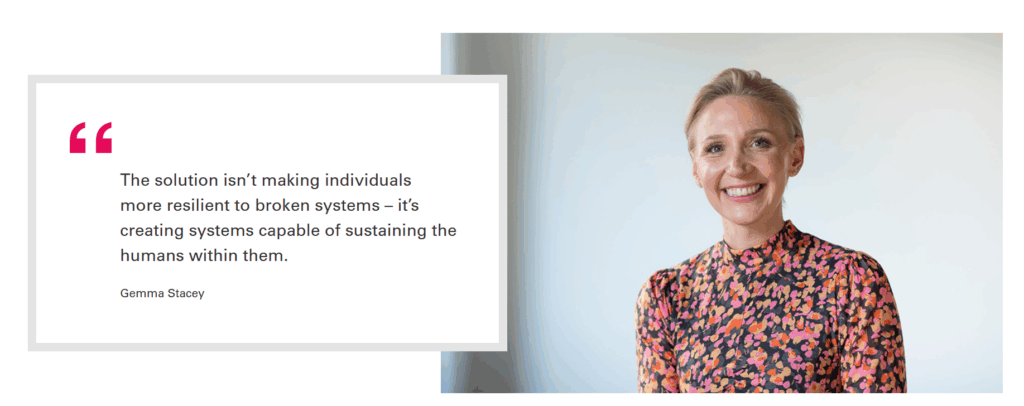
The nursing workforce crisis is real. The pressures are immense. But the solution isn’t making individuals more resilient to broken systems. It’s creating systems capable of sustaining the humans within them.
*This blog is based on Professor Stacey’s Inaugural Lecture “Reframing and reclaiming resilience for a sustainable healthcare system”, delivered at NTU in Nottingham in November 2025.