NEWS

Want to preserve biodiversity? Go big, researchers say

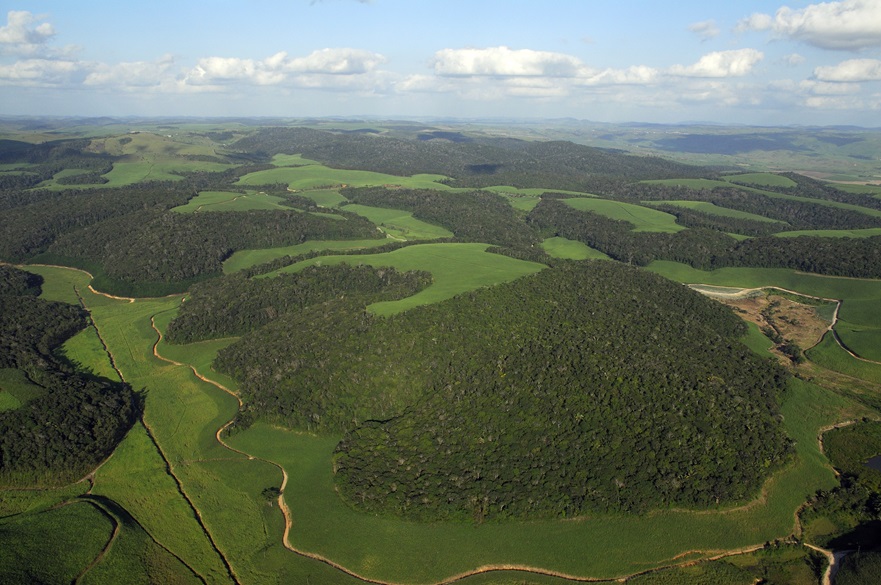
Image: Adriano Gambarini

Ecologists agree that habitat loss and the fragmentation of forests reduces biodiversity in the remaining fragments.

They do not agree, however, on whether it’s better to focus on preserving many smaller, fragmented tracts of land, or larger, continuous landscapes.

The study, led by the University of Michigan and involving Nottingham Trent University (NTU) comes to a conclusion on the decades-long debate.

“This puts an end to a long-lasting theoretical debate with strong practical consequences for conservation,” said Dr Felipe Melo, Associate Professor in Ecological Restoration in NTU’s School of Animal, Rural and Environmental Sciences.

“Fragmentation is bad,” said study author Nate Sanders, professor of ecology and evolutionary biology at the University of Michigan.

He said: “This paper clearly shows that fragmentation has negative effects on biodiversity across scales. That doesn’t mean we shouldn’t try to conserve small fragments when we can with our limited conservation dollars, but we need to be wise about conservation decisions.”

The study examined 4,006 species of vertebrates, invertebrates and plants sampled at 37 sites around the world to provide a global synthesis comparing biodiversity differences between continuous and fragmented landscapes.

They found that, on average, fragmented landscapes had 13.6% fewer species at the patch scale, and 12.1% fewer species at the landscape scale.

Additionally, the findings suggest that primarily generalist species—species that are good at surviving in various environments—live in the fragmented areas.

The scientists investigated what’s called alpha, beta and gamma diversity at these sites. Alpha diversity refers to the number of species in a patch, while beta diversity refers to how species composition differs between two areas. Gamma diversity refers to biodiversity over a whole landscape.

This puts an end to a long-lasting theoretical debate with strong practical consequences for conservation

Dr Felipe Melo, Nottingham Trent University

The study was led by ecologist Thiago Gonçalves-Souza, a research scientist from the Institute for Global Change Biology at the University of Michigan.

He said: “The heart of the debate is that people who argue that fragmentation isn’t so bad say that because you have isolated habitats, you have different species composition, which means at a large scale, it’s good: if they are different, we can assume that the gamma diversity is going to be higher.

“They say the opposite for large tracts of land: because this is a continuous and homogeneous patch, the species composition is too similar.”

But previous research didn’t properly compare fragmented landscapes to large, continuous forests, he added.

For example, prior research may have looked at only one component of diversity, or may have compared a few continuous forests to dozens of fragmented patches.

Gonçalves-Souza and colleagues instead constructed an analysis that corrected for differences in sampling across different landscapes.

The group discovered that fragmentation decreased the number of species across all taxonomic groups, but that the increase in beta diversity in fragmented landscapes did not compensate for species diversity loss at the landscape level.

Gonçalves-Souza says that biodiversity isn’t the only thing lost when landscapes become fragmented: the ability of the landscape to store carbon is compromised as well.

“People are also comparing these two situations and finding that we are losing the ability for landscapes to store more carbon in fragmented landscapes,” he said.

“Fragmented landscapes are not only going to affect biodiversity by decreasing alpha and gamma diversity, but it also has implications for carbon stock as well.”

Gonçalves-Souza hopes the study can move the conservation community past the debate over continuous versus fragmented landscape, and focus on restoration of forests.

“I don’t know if it’s useful to think about continuous versus fragmented landscapes. We need to protect biodiversity and I think this debate is not helping to actually support conservation,” he said.

“In many, many countries there aren’t many large, intact forests remaining. Therefore our focus should be on planting new forests and restoring increasingly degraded habitats. Restoration is crucial for the future, more so than debating whether it’s better to have one large forest or many smaller fragments.”

The study, which also involved researchers from Michigan State University and the German Centre for Integrative Biodiversity Research, among others, is published in the journal Nature.
Bumper year for Science in the Park with brain scans, Gorilla DNA and robot building wowing the crowds

Scientists from the University of Nottingham and Nottingham Trent University joined forces to showcase their research at ‘Science in the Park’, a free annual festival at Wollaton Hall that takes place as part of British Science Week.

Tickets for the free event were snapped up in record time with all available tickets going within 48 hours and 4,000 visitors attended the event.

The popular family event featured more interactive exhibits than ever which were suitable for pre-school children through to adults and for the first time the exhibits were also upstairs in the hall.

The ‘Brain Team’ from the University of Nottingham’s School of Computer Science demonstrated different types of wearable brain scanning devices to find out how people would feel about using this new type of consumer neurotechnology.

Nottingham Trent University engineers were able to help visitors experience how bees and butterflies viewed the world and forensic science students challenged children and adults to become crime scene analysts and match fingerprints using different light wavelengths to identify minute differences.

Visitors also had the chance to build their own robots, with experts from the Cobot Maker Space holding workshops to build and programme robots – plus demonstrations from some robot special guests!   

The University of Nottingham’s team from Life Sciences were alongside George the gorilla, giving visitors the opportunity to see George’s hairs under the microscope. Tom Hartman is part of the University of Nottingham team working on a project to discover the origins of George by analysing DNA. Using state-of-the-art facilities at the Nanoscale and Microscale Research Centre (nmRC) he recovered four hairs from the taxidermy gorilla at Wollaton Hall and prepared them for microscopy that visitors could see.

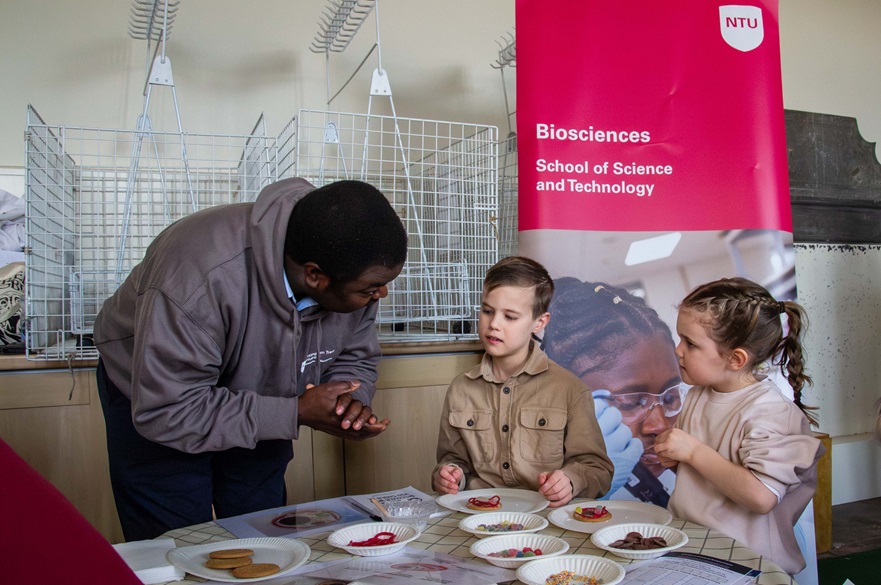
Biomedical scientists from NTU showed how disease is detected in blood and urine and families dressed up as scientists and operated on a mannequin, performing lab tests and building microbes from plasticine.

People discovered what the cells that make our bodies are made of while making fun and tasty cell biscuits, extracted DNA from strawberries using everyday household items and learned the science behind balance and strength.

Visitors also fished for “poo germs” in a ball pit pond, discovering how such microbes are counted and studying their superpowers in the lab.

Professor Kirsty Smallbone, Executive Dean for the School of Science and Technology at Nottingham Trent University, said “It was an extremely busy and fun-filled event, and fantastic to see science and engineering presented in an accessible and hands-on way to people of all ages.”

The University of Nottingham’s Institute for Policy and Engagement, Maria Richards, Head of Public Engagement said: “Every year we have a bigger and better offer for visitors to this popular event and our volunteers go all out to create activities that are fun, educational and engaging. It’s a great way to showcase the important research that’s happening at the city’s two Universities, making it accessible, and hopefully inspiring future generations of scientists.”

Visitors also had the opportunity to explore the Hall, including its Natural History Museum with the Living Planet, Changing Planet, and Taxidermist’s Tale galleries.

Cardiff Met launches new programme of art and design short courses

Cardiff Metropolitan University’s School of Art and Design is launching a range of new evening and weekend short courses open to all abilities, giving people the opportunity to hone their skills at the university’s professionally equipped studios and workspaces.

From pottery to painting, drawing to design thinking, photography, printmaking and craft courses, there is something for everyone, with eight courses running during the summer term.

The following courses are now available to book:

  • Introduction to Drawing, Wednesdays from 30 April 2025
  • Life Drawing, Tuesdays from 29 April 2025
  • Painting the Human Figure, Saturday 10th and Sunday 11th May.
  • Introduction to Acrylic Landscape Painting, Thursdays from 1 May 2025
  • Still Life Painting – composition and colour, Saturday 5 and Sunday 6 July 2025
  • Creative Flow workshop: Acrylic & Mixed Media Funky Abstract Expressive Portrait, Saturday 3 and Sunday 4 May
  • Reduction Linocut Printing, Tuesdays from 29 April 2025
  • Stencil Screen Printed Lampshades, Wednesdays from 30 April 2025

Dr Bethan Gordon, Dean of the School of Art and Design at Cardiff Met said: “Cardiff School of Art and Design’s short courses run throughout the year at our Llandaff campus and are designed to suit all learners. It doesn’t matter if you are an experienced artist or designer, considering returning to Higher Education and preparing your portfolio, or are just keen to learn a new skill – there is something for everyone.

“Anyone who takes part in the courses will have the opportunity to learn from our experienced tutors, working in some of the excellent studio spaces available in the Cardiff School of Art and Design, alongside likeminded learners.” Please note that bookings for all courses will close exactly one week prior to the start of the course.

UK work visa changes criticised as new immigration rules loom

There had been a significant increase in the number of people holding a Skilled Worker visa claiming asylum in the UK

Changes to the skilled worker visa route for foreign workers were made without understanding the impact it would have and resulted in thousands more migrants claiming asylum in Britain, a watchdog has found.

There had been a significant increase in the number of people holding a Skilled Worker visa claiming asylum – up from 53 claims in 2022 to 5,300 in the first 10 months of 2024, the National Audit Office (NAO) revealed on Tuesday.

It comes as the Government prepares to publish a White Paper, expected in the summer, which will lay out plans “to restore” the UK’s “broken immigration system”.

Far more foreign workers are also using the Skilled Worker route to come to Britain than the Government anticipated, the spending watchdog said in its report.

The Home Office forecast that it would issue 360,000 of the visas to people entering the country over the first three years, but has issued 931,000.

The route was first introduced in 2020 in a bid to bring much needed workers to the UK. But there have been significant changes to the rules since then and they “have not always been based on a full assessment of potential impacts”, the watchdog said.

Requirements for foreign care workers were eased in 2022 because of significant staff shortages in the sector. However, in spring last year the Home Office tightened visa rules and implemented a ban on workers bringing dependants to Britain with them as part of the previous Government’s bid to cut record levels of immigration.

“The Home Office does not have a full understanding of how the Skilled Worker visa route is operating, the NAO report states.

“More people are using the Skilled Worker visa route than the Home Office anticipated in 2020…This has brought benefits. In December 2024, the Migration Advisory Committee conducted analysis which suggests that, on average, migrants on Skilled Worker visas have a positive net fiscal impact on government finances.

“However, the higher-than-anticipated use of the route also has consequences, such as an 80% increase in people staying permanently in the UK in 2024, compared with 2021; a 360% increase in the number of dependants entering the UK annually, from 55,200 in 2021 to 254,100 in 2023; and the number of people claiming asylum after entering the UK on a Skilled Worker visa rising.”

The Home Office reviewed the use of the route in 2022, but did not assess the impact of changes to entry requirements since its expansion to include care workers.

It resulted in the Government not “fully understanding” how the route is being used, its contribution to the economy, or impacts on skill shortages across sectors or regions.

The NAO said impacts of changes since the 2022 expansion to include care workers had not been assessed.

The watchdog recommended that a Home Office evaluation of the route should be published within the next three months and an assessment of what happens to people at the end of their visa period should be completed by the end of the year.

Last week, the Home Office announced new visa rules for providers, workers and students.

Employers will have to prioritise hiring foreign carers already living in England before recruiting from overseas, under the measures laid in Parliament.

The minimum salary required for Skilled Worker visas is also being increased. From April 9 it will rise from £23,200 per year to £25,000 (or £12.82 per hour).

The Home Office also revealed more than 470 sponsor licences in the care sector had been revoked between July 2022 and December 2024 in a crackdown on abuse and exploitation in the visa system.

More than 39,000 workers were associated with those sponsors since October 2020, the department said.

Migrant help charity the Work Rights Centre said the figures are a “shocking revelation of the scale of fraud and exploitation under the sponsorship system”.

Gareth Davies, head of the NAO, said: “The Home Office, and departments, must make better use of data to understand the impacts of changes to the Skilled Worker visa route, improve customer experiences and prevent the exploitation of visa holders.”

Sir Geoffrey Clifton-Brown, chairman of the Public Accounts Committee, said it was “disappointing that the Home Office lacks a clear understanding of how the system is currently functioning, including what happens to people when their visa ends, and the impacts of changes made to the visa route”.

A Home Office spokesperson said: “We welcome the National Audit Office’s report. This government has already begun work to implement many of their recommendations, including a new joined-up approach between Skills England, the Department for Work and Pensions, and the Industrial Strategy Council alongside the independent Migration Advisory Committee.

“Under the Plan for Change, we will go further and publish a White Paper to restore order to our broken immigration system. This will link our immigration, skills and visa systems so we can grow our domestic workforce and end the reliance on overseas labour to boost economic growth.”