NEWS

NTU holds successful Science and Tech Careers Day for 300 schoolchildren at Sherwood Observatory

A successful career aspirations event was held at Sherwood Observatory last week (24th March) to demonstrate the wide range of science and technology career opportunities available for local secondary school students aged 14-18 from Ashfield.
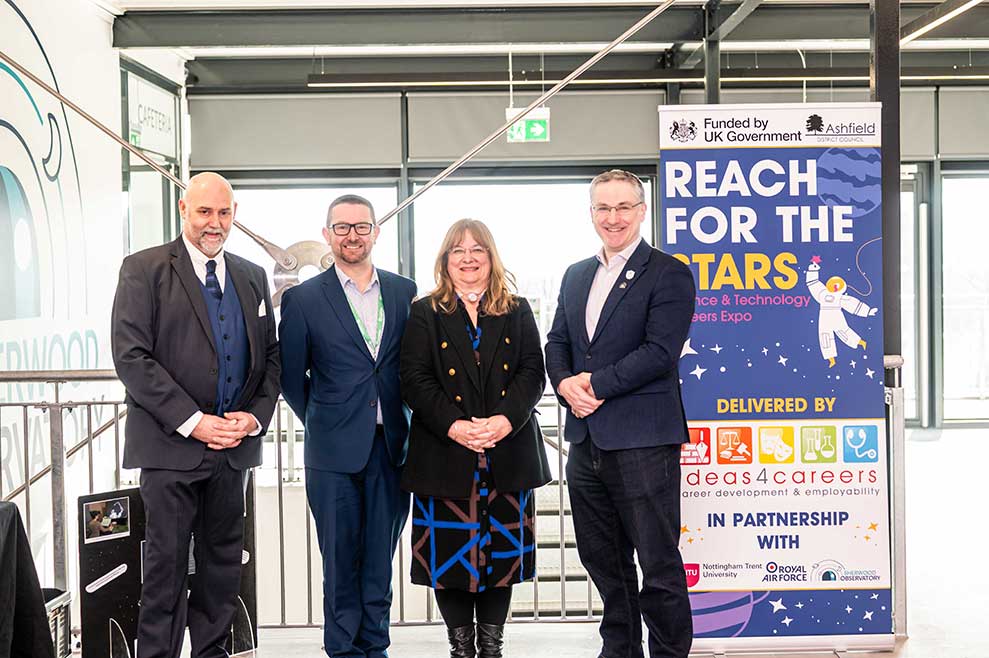
(L-R) Jon Wright (NTU) , John Bennet (Ashfield District Council), Michelle Taylor (Ideas4Careers), Councillor Matt Relf (Ashfield District Council)

Run by Ideas4Careers in partnership with NTU, with the theme ‘Reach for the Stars’, the event saw over 25 local science and technology exhibitors gather for the day, from the RAF Youth STEM team, Hucknall Air Museum and local businesses including ITP Aero, Glenair, Dassault Systemes, Environment Agency, GXO, Connect Fibre, Flannery, ATTFE, Mesh Training and further and higher education partners from the sector including robotics from West Notts College.

In addition, the attending schools took part in a series of planetarium shows and hands-on activities throughout the day from various science and technology providers.

The successful event was part of the Aspiring Careers Ashfield project led by Ideas4Careers, funded by Ashfield District Council through the UK Shared Prosperity Fund, and supported by NTU’s School of Science & Technology. The event also received a donation from the RAF for equipment for the Observatory. It is hoped that the event will become a main stay in the academic calendar in the future.

Jon Wright, Undergraduate Course Leader for Forensic Science at Nottingham Trent University, and also Outreach Co-ordinator for the School of Science & Technology said: “We have been overwhelmed at the response we’ve had to this event, both from the schools attending and the exhibitors. It’s really shown that there is an appetite for careers in STEM in the local area, and we hope we’ve been able to give some young people real options for the future.”

Michelle Taylor, Managing Director, Ideas4Careers said: “The event was a resounding success, providing students with engaging interactions that sparked their interest in STEM. We are excited about the positive impact it has had on the students’ interest in science and technology careers as well as broadening their knowledge of related industries here in Ashfield. Exhibitors from various industries were thrilled to share valuable insights into career paths and practical applications of STEM skills, while also highlighting the importance of these roles in today’s world. This  was education/business collaboration at its best. We hope the success of this event will lead to future events.”

Cllr Arnie Hankin, Chairman of Ashfield District Council said: “This event was a fantastic opportunity to showcase the exciting career paths available for students in science and technology. It was great to be able to hold it at the newly opened Sherwood Observatory which provided a fitting backdrop to the event. By connecting students with industry professionals, we are helping to build a strong, skilled, and diverse workforce that will benefit the future of Ashfield.”

Feedback from the day included:

“Great planetarium experience and lots of great career advice and pathways available”

“I liked looking at the fingerprints and discovering which one was mine”

“Lots of opportunities to learn and see new technology”

“My most enjoyed activity was the VR car”

“I liked the 3D in person gravity sketch, could see myself working in 3D modelling”

Gender-affirming care key to transgender men’s health and happiness

Body image and quality of life among transgender men could be improved with more gender-focused care, according to research by Nottingham Trent University in the UK and Breda University of Applied Sciences in the Netherlands.

The study questioned 166 trans men on aspects of gender congruence – the feeling of harmony between a person’s gender identity (how they see themselves) and their physical appearance or how others perceive them; and body satisfaction.

In a unique approach, it also measured quality of life across four areas; physiological; psychological; social; and environmental.

Findings showed that when trans men feel that their gender identity matches their appearance, they are happier with their bodies and overall wellbeing.

In relation to quality of life, feeling good about their gender was seen to help trans men with their physical health, mental health, and feeling safe in their environment.

However, gender congruence was not seen to impact on their social lives, possibly reflecting the unique shared-experience bonds formed among this community.

Dr Liam Cahill, lead researcher and senior lecturer in LGBTQ+ Psychology at NTU’s School of Social Sciences, said: “While research already shows a link between gender congruence and body satisfaction, their intersection with quality of life for trans men has so far been neglected. Understanding this complex relationship is critical to developing the right support for trans men.”

The study also examined how gender-affirming care, like hormone therapy and chest surgery, affects quality of life, gender congruence, and body satisfaction. Both types of care significantly improved gender congruence and indirectly boosted body satisfaction. Chest surgery was linked to better physical, mental, and environmental quality of life, while hormone therapy improved mental and environmental quality of life.

Dr Cahill added: “Gender-affirming care might not change how people see their bodies directly. Instead, it helps their physical appearance match their gender identity, which is crucial for feeling satisfied with their bodies. These findings highlight the need for accessible gender-focused care that supports both gender congruence and body satisfaction, helping to improve the overall well-being of trans men.”

Understanding the Role of Gender Congruence and Affirming Care in Trans Men’s Body Image and Quality of Life by Dr Liam Cahill, Chase Staras, Dr Treshi-Marie Perera, Dr Beth Jones, and Professor Daragh McDermott is available to read via the International Journal of Transgender Health.

NTU Mansfield launches BA Hons Social Work degree financially supported by Nottinghamshire County Council

Hosted at the NTU Mansfield Hub on the West Notts College campus, commencing in September 2025

Nottingham Trent University (NTU) in Mansfield is launching a new BA (Hons) Social Work degree commencing study in September 2025.

The three year full-time undergraduate degree will allow students to study on-site at NTU’s Mansfield Hub for the first time – previously only available on NTU’s City campus.

Students will be able to learn all the theory and practical skills needed for a career as a social worker, delivered by experts with over 170 years’ professional experience in the sector.

The course will give students the opportunity to develop new perspectives and challenge ideas from a wide range of sources including employers and local social work partners, and on graduation, will have a deep understanding of current practice.

Topics covered include the impact of digital tools in social work, from online assessments to communicating with service users through text and WhatsApp, how to understand human behaviour, responses to trauma and loss, and views on family and society.

Learning will comprise of a mixture of lectures, seminars, and workshops together with using some of the latest technology available to re-create real-world scenarios and case studies. However, study isn’t limited to the classroom, as there is a guaranteed 170 days of practice placements included as standard in years two and three.

There is also the potential for 10 students to be sponsored by Nottinghamshire County Council (NCC) for the duration of the course – with a bursary to pay course fees each year for three years and £2,000 per year contribution towards living expenses.

As part of the sponsorship, for these 10 students, Nottinghamshire County Council will guarantee two practice education placements in the Children and Families Department or Adult Social Care and Health Department. Upon graduation, employment opportunities will be offered with Nottinghamshire County Council in Mansfield, Ashfield or Bassetlaw.

To be eligible for sponsorship, prospective students must:

  • Live in Nottinghamshire, or
  • Be a Nottinghamshire County Council employee, and
  • Agree to work for Nottinghamshire County Council as a social worker for three years after successfully completing the course

Nottinghamshire County Council will select successful recipients from the pool of eligible applicants.

Simon Cauvain, Head of Social Work, Care and Community at Nottingham Trent University said: “This course is a fantastic opportunity to make a difference in the Mansfield, Ashfield or Bassetlaw communities, where there is a need for qualified social workers. Social work is a challenging career, but hugely rewarding, and this course will give students the best preparation possible to become a professional social worker and be able to tackle big issues to help individuals and families in the local community.”

“Our social work degree isn’t just a course, it’s a chance to reflect on your own ideas and challenge yourself, and make you more resilient, determined and give you the passion to work in the sector. You’ll join the social work family, develop new connections and benefit from our years of experience and links in the industry.”

Colin Pettigrew, Executive Director for Children, Families and Cultural Services at Nottinghamshire County Council said: “Nottinghamshire County Council is delighted to both be part of the partnership with NTU and West Notts College and to co-design this innovative programme. It is important that Social Workers and other public servants: teachers, nurses, police officers are representative of the communities that they serve and this degree will give people living in and around Mansfield, Ashfield and Bassetlaw not only the chance to study at degree level but also give them every opportunity to secure a professional qualification and a career at the end of it. Making a difference to local children, families and vulnerable adults.”

Andrew Cropley MBE, Principal and Chief Executive at West Nottinghamshire College said: “I am delighted that we have played a small part in creating another great opportunity for local people to access rewarding, well-paid and skilled careers, whilst meeting a very important skills need. I hope that our Access to Higher Education programme might provide a first step for some into these courses.”

Access to justice in crisis: regulators must step up now

A groundbreaking report, ‘Regulatory Leadership on Access to Justice’, commissioned by the Legal Services Consumer Panel (LSCP) in collaboration with the Legal Services Board (LSB), has issued an urgent call to action for legal services regulators to tackle the growing crisis of unmet legal needs in England and Wales.

Conducted by Nottingham Law School, part of Nottingham Trent University, the report highlights the critical role regulators must play in ensuring access to justice for all, particularly for the most vulnerable in society.

According to LSB’s own research[1] in England and Wales, 3.6 million adults have an unmet legal need involving a dispute. And nearly nine in ten say ‘the law is a game in which the skilful and resourceful are more likely to get what they want’.

Resolving legal issues can lead to significant improvements in health, income, housing, and employment, yet too many individuals are experiencing dwindling and no access at all. The report draws on innovative approaches from regulators in jurisdictions like Canada and Australia, demonstrating that whilst government funding is critical to access to justice — it is also about regulatory creativity, collaboration, and removing barriers. It calls on regulators in England and Wales to take inspiration from abroad and act decisively.

Key Recommendations:  
The report identifies several systemic barriers to access to justice, including the closure of legal advice centres, legal aid deserts, and a lack of public awareness about legal rights. It calls on the LSB and frontline regulators to take a proactive leadership role in addressing these challenges. There are a number of key recommendations, including:

  • Revising Codes of Conduct: Frontline regulators, with strategic direction from the LSB, should revise codes of conduct to place greater emphasis on access to justice, the rule of law, and equality before the law.
  • Innovation Sandboxes: The LSB should explore the creation of an access to justice innovation sandbox to test and trial new solutions.
  • Cross-Sector Collaboration: The LSB should lead efforts to foster collaboration across sectors, including government, charities, and other regulators, to address systemic causes of injustice.
  • Public Legal Education (PLE): Regulators should support tailored and strategic PLE initiatives to empower individuals with knowledge of their legal rights and duties.
  • Regulation of Paralegals: The LSB should investigate mandatory regulation of paralegals to expand the pool of trusted intermediaries who can assist the public in navigating legal processes.
  • Holistic, People-Centred Services: Regulators should promote integrated legal services that address barriers to access, particularly for disadvantaged groups

Dr Liz Curran, Associate Professor, Nottingham Law School:
“Ensuring access to justice is essential for tackling inequality. For too long, efforts have been limited to superficial fixes, failing to address a deep-rooted issue that disproportionately affects the poorest and most disadvantaged.

“Maintaining the status quo is not an option, as both statistical and qualitative data highlight the real harm caused by inaction. A creative, problem-solving, and evidence-based approach is crucial.

“This research report demonstrates what can be achieved and how. It showcases successful examples of intentional regulatory action in other jurisdictions that have improved access to justice. It offers a wealth of ideas for action at multiple levels and in various ways. Under the leadership of the oversight regulator, the LSB, all regulators have a role to play, and collaboration across sectors is key to driving progress.”

Tom Hayhoe, Chair of the Legal Services Consumer Panel:
“Access to justice is a fundamental right, yet too many do not have access to the information, advice, and help they need. This report is firmly focused on what regulators can do, because they have a statutory obligation to act—and we are convinced they have levers yet to be utilised to advance this mission. We are asking all regulators, including the LSB, to step up and act now. We need bold, coordinated action to improve the status quo.”

Catherine Brown, Interim Chair of the Legal Services Board:
“One of the most pressing challenges facing the legal sector is unmet legal need. Too many people in England and Wales do not get the help they need when faced with a legal problem, particularly if they are on a low income or in a vulnerable situation. This report makes detailed recommendations to us and the frontline regulators, which we will carefully consider in relation to our statutory duties, the broader regulatory framework and the interests of the public.”

The full Regulatory Leadership on Access to Justice report can be found here.

Development Bank Wales invests in Cardiff Met spinout company

A spinout company from Cardiff Metropolitan University has secured investment from Development Bank Wales to build a powerful new form of imaging technology that could revolutionise the way people view and make images.

The partnership between Fovo Technology Ltd. (Fovotec) and Development Bank Wales – a major provider of investment funds and commercialisation expertise – will enable the development of Dynamic Projection.

Based on research from artists and scientists into how human vision works, ‘Dynamic Projection’ allows technology to generate images that are closer to how humans ‘see’.

Fovotec, which was founded in 2017 by interdisciplinary academics at Cardiff Met, has so far secured 15 international patents to protect its novel process, with several more pending.

The range of potential applications is vast and includes computer games, smartphone cameras, cinematography, medical imaging, security, defence and communications.

Dr Robert Pepperell, Co-Founder of Fovotec and Professor of Fine Art at Cardiff Metropolitan University, said: “It’s taken many years to solve the problem of how to make wide angle images look natural in imaging media.

“This new investment from Development Bank Wales creates an incredibly exciting opportunity to deliver Fovotec’s solution to leading technology companies around the world. We do not think it will be long before we see Fovotec’s Dynamic Projection appearing in computer games titles and other consumer technologies.”

Development Bank Wales and Fovotec are now exploring opportunities with major technology companies to integrate Fovotec’s Dynamic Projection tools into leading brand products.

Chairman of Fovotec, Frank Holmes, said: “We have witnessed the evolution of this patented invention from its early conception and are hugely excited about its extensive commercialisation prospects, some of which are imminent.

” Professor Sheldon Hanton, Pro Vice-Chancellor for Research and Innovation at Cardiff Metropolitan University, added: “Cardiff Met is very much at the forefront of imaging innovation globally and this significant investment from Development Bank Wales will enable our academics to continue to develop this groundbreaking technology.”

Adam Ramzaan, Investment Executive at the Development Bank of Wales said: “We’re thrilled to be supporting Fovotec at this exciting stage of their journey. Their pioneering work in human-centred imaging and real-time rendering technology has the potential to transform industries. This investment reflects our strong belief in the team’s vision, technical excellence, and commercial potential.”

Dyslexia ‘invisible’ in schools amid parent-teacher divide on support

Parents of children with dyslexia feel that the condition is largely ‘invisible’ in schools, with a lack of recognition leading to inconsistent and ineffective support.

A study carried out by researchers at Nottingham Trent University (NTU) and the University of Birmingham explored the real-life experiences of parents and teachers regarding children who have reading and writing difficulties, and whether a formal diagnosis of dyslexia improves support.

Findings of interviews with 39 participants highlighted a disconnect between parents’ concerns for their children’s long-term wellbeing and teachers’ focus on short-term classroom management. The study identified 40 factors that appeared to work in different combinations to influence if a child’s access to education was on a positive or negative trajectory.

The families saw dyslexia as something that affects not just reading and writing skills, but also their child’s confidence, ability to learn in the usual school environment, their overall wellbeing, and importantly their inclusion. They felt that their children were not truly included and supported, leading to a loss of independence and frustration for both the children and their parents.

While teachers acknowledged the need for literacy support, their perspectives were often shaped by the immediate need to manage a diverse group of learners within existing policies and resource limitations. Their focus tended to be on the collective progress and the smooth running of the classroom. They were also constrained by varying levels of knowledge about dyslexia.

However, the study did reveal areas of best practice when teachers were well-informed through experience or additional training and were able to meet a child’s needs and foster a sense of inclusion and community within their schools. Effective communication and shared understanding between parents and teachers also resulted in more successful outcomes.

The paper, published in the journal Dyslexia, also considered the value of a formal dyslexia diagnosis and its impact on support, as many parents sought a diagnosis to help them navigate the education system.

This research highlights the harm faced by children with literacy difficulties and underscores the importance of diagnosis for visibility, awareness, and effective management. Our study found dyslexia to be relatively invisible in mainstream schools.

Lead researcher Dr Angela Thompson, Visiting Scholar, NTU Psychology

Professor Julia Carroll, Professor of Psychology in Education at the University of Birmingham, said: “We believe that the gap between parent and teacher perspectives can be partially bridged through the effective and consistent diagnosis of dyslexia, which serves as a conduit for shared communication and understanding, making a child’s unique needs more visible. This visibility is crucial, as dyslexia can affect various aspects of life both in and beyond school. This underscores my recent work on an updated definition of dyslexia.”

Professor Clare Wood, director of the Centre for Research in Language, Education and Developmental Inequalities at NTU, added: “The identification of dyslexia is important in improving the visibility and understanding of a child’s learning difficulties. The absence of a diagnosis can, and did, result in significant negative consequences for a child’s education.

“We found that some schools did not acknowledge or act on a diagnosis, instead falling back on local policies. A diagnosis alone does not currently guarantee appropriate support, and its value is realised only when it is acknowledged and acted upon by those responsible for the child’s education.”

Read the full paper on the Dyslexia website.

Why Every Business Should Consider an Apprentice

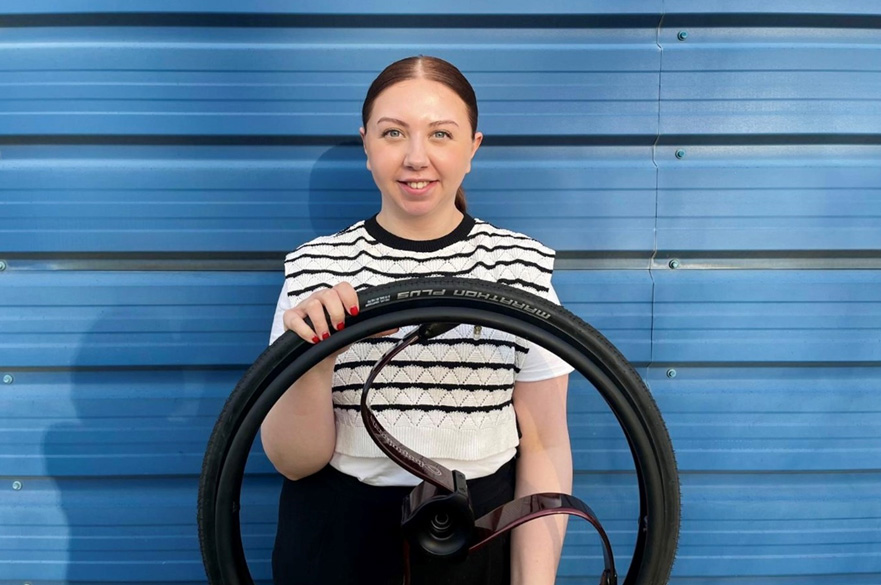
Gemma Pearce talks about why hiring an apprentice proved to be a game-changing decision for her business, Loopwheels.

Ellie James, Apprentice at Loopwheels

There has been a lot of gloom in business circles about the cost of employing staff since last October’s Budget announcement on changes to National Insurance and increases in the National Minimum Wage/National Living Wage.

One of the worries expressed is around the increase in the hourly pay rate for apprentices in April 2025, which puts pressure on raising pay levels for those employees with more experience to maintain fairness across the whole team. Some employers have questioned if investing in apprentices stacks up against taking on an older, more experienced staff.

Hiring an apprentice was the best business decision I made in 2024. I’d even go so far as to say it may prove to be one of the best decisions I have made for my small manufacturing business in the last decade!

As we reflect on National Apprenticeships Week 2025, I’m reminded that it was around this time a year ago when I wrote and issued an advert for our first apprentice.

Why did we decide to go down the apprenticeship route?

A key challenge for our micro-sized manufacturing business was how we could afford to bring in an expert dedicated digital marketing resource, who would understand our business and work with us on a medium to long-term basis.

While there are plenty of good digital marketing agencies, and, SMEs can access excellent free and paid-for advice, we knew we needed something more. We explored these options with some good results, however, the time had arrived when we needed someone who would be based within our team, with daily access to our manufacturing site, and could develop our digital marketing strategy and activity from the inside out. We needed someone with more enthusiasm, commitment, dedicated time and growing expertise than the current team or an external adviser could bring to the task. After all, digital media is a voracious beast! For a small manufacturer with a global or international market, it can be incredibly powerful –  but only if it’s fed with consistent, focused effort.

And how has the experience been so far?

I worked with Nottingham Trent University (NTU), to advertise and recruit our degree apprentice, Ellie James. NTU offers numerous degree apprenticeship schemes, including a Digital Marketing Apprentice Degree, which met our needs exactly. It’s a 42-month block release course (3 ½ years), and the apprentice will be an integral part of our team during that time. NTU supported me with every step of the recruitment – I was able to shortlist 70 good-quality applicants. It is in the university’s interests and ours to recruit the right candidate, and their support and experience felt like a true partnership with shared goals.

Our apprentice, Ellie, is a valued employee, we meet the full costs of Ellie’s salary, and she is based in our business and is with us most of the week. Her degree, on the other hand, is funded by the government. The apprenticeship is block-release, on average, in term-time, Ellie spends around three days at Loopwheels, one day a week at university, and a further day a week working and/or studying from home. During the university holidays, Ellie devotes more time to the business.

This arrangement, allows both the business and Ellie, to benefit from the latest digital marketing skills and knowledge the university provides. We apply these skills to the real-life case study of marketing Loopwheels in the UK and internationally, selling our product to around 20 countries.

Ellie joined us in July 2024 to gain some understanding of the business before she began her course at NTU in September. From day one, we could see and feel the positive impact of another intelligent, well-informed, highly motivated and committed team member on our company and digital marketing. Ellie has hit the ground running, and her contribution to our company is tangible and impactful. As she continues through her degree, we’re confident her impact will only grow stronger.

New rules to prioritise recruiting care workers in England

Employers will be required to prioritise recruiting international care workers already in England before recruiting from overseas.

The new rules were laid in Parliament (12 March).

From 9 April, care providers who want to recruit a new worker from overseas will have to first prove that they have attempted to recruit a worker from within England who needs new sponsorship. This ensures that those who came to the UK to pursue a career in adult social care can do so and will help end the reliance on overseas recruitment as we restore order to our immigration system through our Plan for Change. 

Significant work has been ongoing across government, in collaboration with the care sector, to ensure high standards across the immigration system, and to support care workers into alternative jobs when their sponsor has had their licence removed. Under our Plan for Change, we will set out a comprehensive plan to restore order to our broken immigration system, linking immigration, skills and visa systems to grow our domestic skills, end reliance on overseas labour and boost economic growth.

As well as continuing to tackle exploitation, the government is also continuing its clampdown on abuse in the immigration system with changes to the Short-Term Student route. 

The visa is designed for those studying an English language course in the UK for between 6 and 11 months, however, there are rising concerns that the route is being abused by those without a genuine intention to study or to leave the UK at the end of their course. In light of this troubling trend, tough new rules will give expanded powers for caseworkers to refuse visa applications which are suspected of being non-genuine.

Seema Malhotra, Minister for Migration and Citizenship, said:  

Those who have come to the UK to support our adult care sector should have the opportunity to do so, free from abuse and exploitation.

We have already taken action to ensure employers are not able to flout the rules with little consequence or exploit international workers for costs they were always supposed to pay.

We are now going further, requiring employers in England to prioritise recruiting international care workers who are already here and seeking new sponsorship, before recruiting from overseas.

The new requirements continue government action announced in November to crack down on employers who abuse the visa system; barring those who repeatedly break immigration or employment laws from hiring overseas workers and will help support those workers into new jobs.  

The changes announced last year also ban companies from charging workers for the cost of their sponsorship, which has never been intended and led to exploitation, unfair treatment of staff and unsustainable levels of debt in the care sector. 

Between July 2022 and December 2024, the government has revoked more than 470 sponsor licences in the care sector to clamp down on abuse and exploitation. More than 39,000 workers have been associated with these sponsors since October 2020.

Changes announced today will also see the minimum salary thresholds updated to reflect the latest data from the Office for National Statistics (ONS). This will ensure those working on the Skilled Worker visa, including care workers, are paid a minimum of £12.82 per hour. 

Health and education occupations, including doctors, nurses, allied health professionals and teachers, will also see their minimum rates increased to reflect the latest national pay scales. 

Stephen Kinnock, Minister of State for Care, said:  

International care workers play a vital role in our social care workforce. We value their contribution and work supporting vulnerable people across the country every day.

As we crack down on shameful rogue operators exploiting overseas workers here in the UK, we must do all we can to get the victims back into rewarding careers in adult social care.

Prioritising care workers who are already in the UK will get people back to work reducing our reliance on international recruitment, and make sure our social care sector has the care professionals it needs.

The rules come as the government continues implementation of a series of measures to reduce the potential for abuse on the Student and Graduate visa routes.  

Further details of the government’s plan to reduce the staggeringly high levels of legal migration seen in recent years will be set out in the government’s forthcoming Immigration White Paper.

Nottingham students team up with BBC Concert Orchestra to showcase regional talent

The world-famous BBC Concert Orchestra will be returning to Nottingham as part of its collaboration with the Universities for Nottingham initiative – taking part in a week-long series of events coinciding with Nottingham Royal Concert Hall’s Soundstage Festival.

Working collaboratively on a project inspired by journeys, students from Nottingham Trent University (NTU) and the University of Nottingham (UoN) will have a once-in-a-lifetime opportunity to see their creations brought to life by the BBC Concert Orchestra in a performance at the Royal Concert Hall.

Journeys will see a series of short silent films from Filmmaking, Animation, Graphic Design, and Illustration students from NTU, with accompanying bespoke scores from Music undergraduate and postgraduate students and alumni from UoN performed by the Concert Orchestra and conducted by Hugh Brunt.

Amy Bere, Director of Culture at Nottingham Trent University said: “This is the fourth residency week with the Concert Orchestra, and we know from the last year just what an incredible experience this is for the students. It is their chance to not only experience how a professional orchestra rehearses and performs, but to see their own compositions and creations come to life. For some, this will lead to the development of new skills and potentially to employment opportunities which would have otherwise not been open to them.

“It is a wonderful result of collaboration between our universities and the BBC, and we are lucky to be able to share this passion and energy with the wider community of Nottingham in the form of awe-inspiring performances from world-renowned musicians.”

The performance at the Royal Concert Hall takes place on 25th March at 8.30pm, following a BBC Concert Orchestra performance of South at 7pm, a newly commissioned score by Neil Brand, played to the digitally remastered documentary feature, South – the cinematic record of Shackleton’s 1914-16 Endurance expedition to Antarctica.

Professor Jeremy Gregory, Pro-Vice-Chancellor for the Faculty of Arts at the University of Nottingham, said: “Our partnership with the BBC Concert Orchestra offers our students the unprecedented opportunity to gain access to world-class music and experiences, and I am delighted to welcome the orchestra back to Nottingham this spring for more remarkable performances. We are thrilled that the collaboration continues to thrive and showcases the rich musical talent we have in Nottingham, and I am very much looking forward to the Journeys concert!”

The BBC Concert Orchestra also joins forces with NTU and UoN students and alumni for a performance at NTU’s City Campus of Screen Sounds at 7.30pm. The hour-long concert on 26th March will be a trip through some of TV’s best-loved theme tunes, from Bridgerton2001: A Space Odyssey, to Mission Impossible. The orchestra will consist of musicians from the Concert Orchestra and students from NTU and UoN. It will be conducted by Michael Coleby.

Matthew Swann, Director of the BBC Concert Orchestra said: “The partnership between the BBC Concert Orchestra and the universities of Nottingham continues to go from strength to strength, showcasing the talent and creativity of the students and the passion for live performance within the local area. Our fourth residency week explores the relationship between music, TV and film, culminating in a very special Friday Night is Music Night, jam-packed with beloved TV music led by our Chief Conductor, Anna Maria Helsing.”

Over 150 students from NTU and UoN are involved in BBC Concert Orchestra events during this residency week. This partnership provides Nottingham students with exceptional professional and performance experiences and opportunities, bringing them into direct contact with a world-class and world-renowned orchestra in meaningful ways which contribute to their studies and to their professional skills.

The week of events will culminate in Friday Night is Music Night at the Royal Concert Hall on Friday 28th March at 7pm.

Five years on from COVID-19: New research highlights why bacteria causing childhood infection took so long to return post pandemic

Researchers from Cardiff Metropolitan University and University Children’s Hospital Zurich have identified why a bacterium responsible for respiratory tract infections, which disappeared during the COVID-19 pandemic, took significantly longer than other infections to return.

The study – which looked at the bacterium Mycoplasma pneumoniae and represents the most comprehensive analysis of the infection to take place – was recently published in the prestigious scientific journal, The Lancet Microbe.

Mycoplasma pneumoniae (Mycoplasma) is a major cause of respiratory tract infections in children. Although most infections are mild and self-limiting, Mycoplasma can cause severe pneumonia or infections that require hospitalisation.

The report, ‘Global spatiotemporal dynamics of Mycoplasma pneumoniae re-emergence after COVID-19 pandemic restrictions: an epidemiological and transmission modelling study’ involved creating the largest global dataset for Mycoplasma infections following the COVID-19 pandemic – working with 65 diagnostic laboratories, from 29 different countries worldwide.

Dr Mike Beeton is a Reader in Medical Microbiology at Cardiff Metropolitan University and has been co-leading on the research.

Dr Beeton said: “When various control measures, such as social distancing and lock downs were relaxed, many bugs, such as flu and RSV, returned within a few months. However, Mycoplasma did not. For this reason, we wanted to work with other scientists and clinicians across the globe to identify where and when this infection had returned. Our research found Mycoplasma to be largely absent for over three years and it made a substantial re-appearance in many countries at the end of 2023.

“Our research suggests this delay was due to COVID-19 restrictions being 90% effective at initially reducing the spread of Mycoplasma during the early stages of the pandemic. This reduction in the amount of Mycoplasma circulating in the community, in combination with the poor ability to spread from person to person, helps to explain why it took so long for these infections to return.”

Key findings from the report highlight:

  • Despite the unprecedently high number of Mycoplasma detections during re-emergence, the study found that fortunately, overall severity and the number of deaths remained low.
  • In some regions, nine out of ten Mycoplasma cases were resistant to the first-line of antibiotic treatment. To assess whether resistance patterns had shifted following the bacterium’s re-emergence, the team examined data from multiple countries.
  • This study highlights the need for unified global reporting of Mycoplasma to better understand how the number of infections changes over time across different countries.

Dr Beeton continued: “Moving forward, we plan to continue monitoring the number of infections across the globe. This is incredibly important as it will help us alert clinicians and medical professionals to an increase in infection and raise awareness as these bacterial infections will require specific antibiotics, which are not routinely given for typical bacterial lung infections.”

Patrick Meyer Sauteur, Consultant in Pediatric Infectious Diseases and Research Group Leader in Experimental and Clinical Infectious Diseases at Children’s University Hospital Zurich, said: “The number of Mycoplasma cases has been truly historic since testing for this pathogen was introduced. Our study first showed how relevant this pathogen really is worldwide. This global collaborative network will enable international surveillance of Mycoplasma and antimicrobial resistance to inform clinicians about the emergence of future epidemics.”